before Game Boy, there was the Microvision
Before 1989, the definition of 'handheld game console' was not set in stone, a specific Nintendo-shaped stone in this case. The same could be said for the video game industry at large. These were the days when America was leading the charge in consumer electronic games products.
Many people, myself included, assumed that the American era of video game consoles was one that yielded little innovation and that it was the Japanese that breathed life into the industry and took us all out of 'The Dark Ages', if you will.
This assumption is demonstrably false once you look into the actual history.
Mattel's Hits
Barring Atari and their home console success starting with Home Pong and evolving into the massive success that was the VCS (2600 is not its original name - I didn't know that until now), there were other players in the arena, including Mattel.
Their success particularly in handheld electronic games with Auto-Race and then Football, showed the world there was such a market, and that you could make millions from it. George J. Klose, development engineer at Mattel, developed the idea for Auto-Race out of a desire to make use of calculator parts. Sound familiar? The game was even written to fit in the existing calculator chip by Mark Lesser.
When I read this anecdote shared by Pad And Pixel, I thought to myself, oh, so this was parallel thinking between the East and the West. Gunpei Yokoi also got the same idea from watching a businessman play with his calculator on the train. I've read about that anecdote a bazillion times, what a coincidence. Great minds really think alike.
And then I learned that the Microvision inspired not just the Game and Watch, but the Game Boy as well.
But first, the Microvision
It looks like a TV remote. It has an unseemly control scheme (imagine instead of pressing on buttons, you had to press the button matrix directly to register an input). It has a whopping 16 by 16 resolution dot matrix LCD display. And I love it.
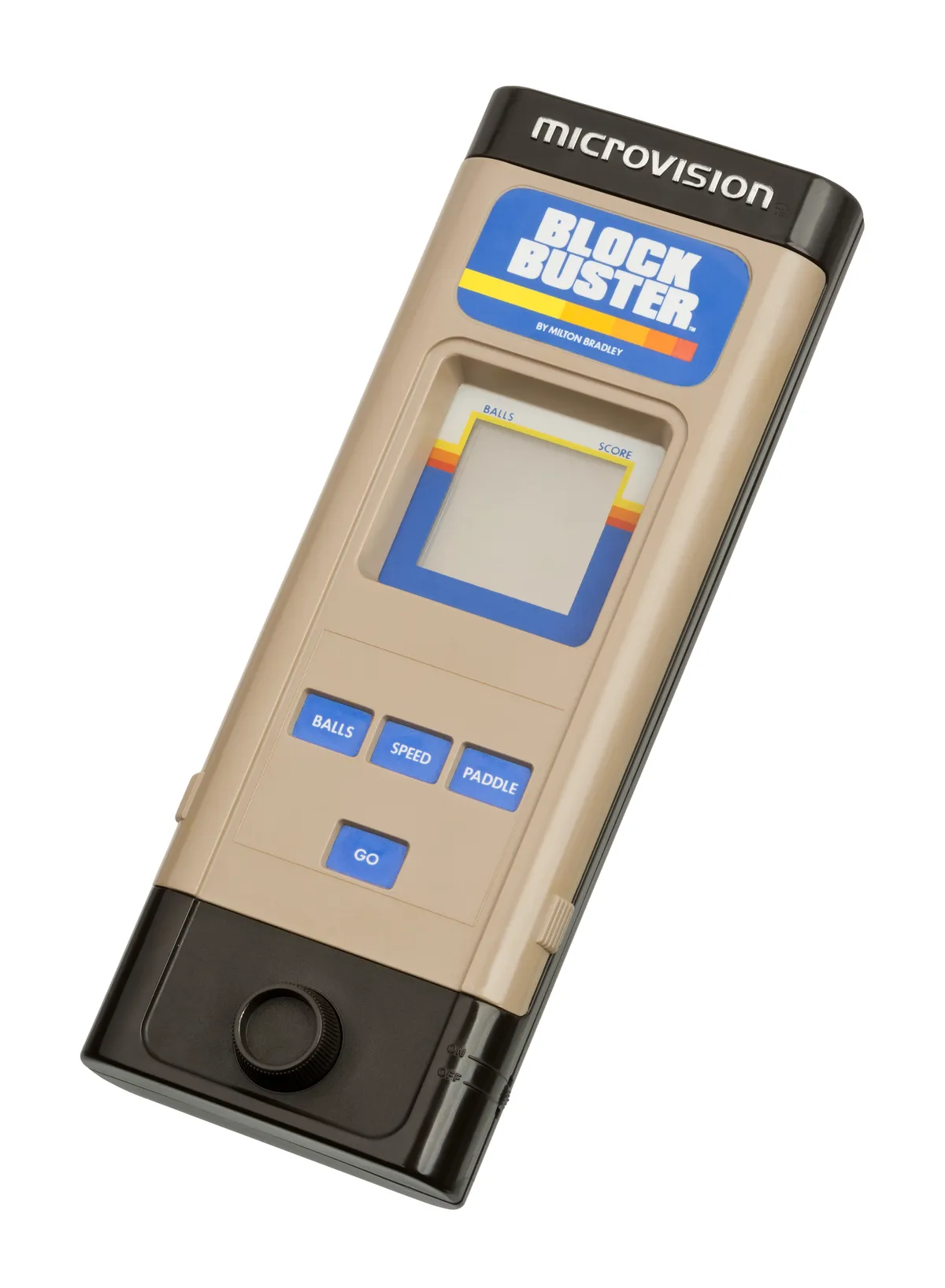
This is so 70s. The beige, the laughably huge form factor, and the fact that it's the first proper handheld video game console, 10 whole years before Nintendo's product. The front case is actually the cartridge, and you can remove the 'cartridge' to put a different 'cartridge' over it and play a different game. Which, yeah, is how a game console technically works. There had never been anything like this ever made, so the engineers and developers for the Microvision had to basically make their own path. For that I am just so impressed and appreciative of how far the technology for handheld games has come.
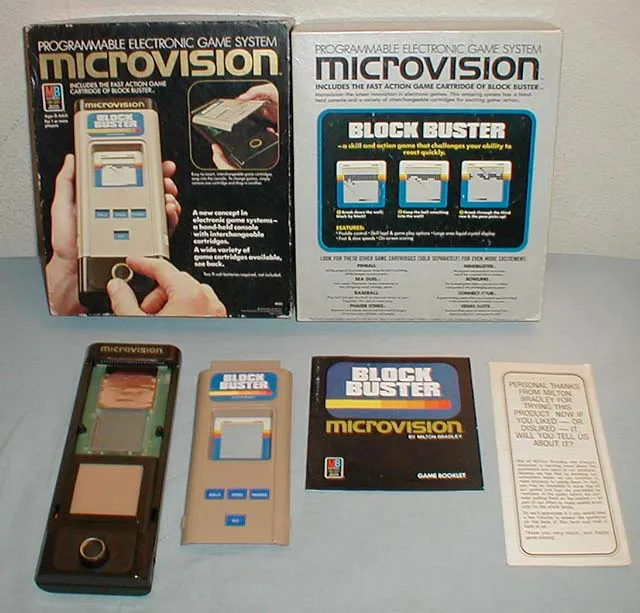
The processors were built into the removable cartridges instead of the main console itself, which is an interesting reversal of how these systems were supposed to work. And the tiny resolution screen meant you couldn't have sprites - every object the player moved, every obstacle, enemy or even projectile - was 1 to 3 pixels. That also requires a lot of creativity to work around that obscene restriction.
I can't even believe the Microvision exists. The fact that they worked through the immense limitations of consumer electronics from 60 years ago to create this is worthy of praise.
But, the story doesn't end here.
Bridging the Link between East and West
According to this article and this interview excerpt, the Game and Watch was directly inspired by the release of the Microvision. This is the quote from Satoru Okada, former designer at Nintendo who worked with Gunpei Yokoi and both those projects.
It is true that Yokoi wanted to create a toy when he saw a man playing with his calculator on the train But to say that this is the sole reason for the Game & Watch is not true. What this memory from the train really created was the will to create a discreet toy for adults so they could kill time while on public transport. The idea to use a calculator screen actually came much later, especially since Yokoi’s knowledge in electronics and screens was rather limited. For me, the real thing that gave birth to the Game & Watch is when we managed to get our hands on an MB Microvision. I loved this machine and played the Breakout clone a lot. But we did not understand why the machine had to be so big! So we first tried to make a portable console that people could really carry in their pockets, except that the screen resolution was very poor and the graphics were very abstract. Besides, we also thought that the idea of interchangeable cartridges was interesting but because of the Microvision’s limitations, all the cartridges looked the same, both with their graphics and the concept of the games. So we said to ourselves: ‘Why not have just one game per machine but with good graphics at least.’ And this is when the idea of using a calculator screen became self evident. All of this led to the birth of the Game & Watch. Yokoi would design the games and l was in charge of the technical part, the electronics even and coding the games.
The idea for the Game Boy was there all the way back in 1980. This completely throws off the narrative that Nintendo first figured out to make game consoles using calculator LCDs and spinning that off into a handheld game console. No, in fact the Microvision is the reason Game and Watch and Game Boy came about.
What a revelation to me. So it's not even parallel thinking, there is a direct line of influence from West to East. How interesting is that?
I suppose, in reality I still would rather play my DS Lite than play the Microvision - I mean the difference in specs alone is night and day. But now I can appreciate the gaming industry even better now that I understand the true influence American games had probably the most successful video game company in the world.
shout out to Pad and Pixel and Nintendo Everything for the webpages I referenced - wouldn't have known the connection between Microvision and Game Boy otherwise!
chunk of coal productions™, 2026.